


Navigating the world of workers' compensation could be stressful. Particularly when your worker's comp checks are delayed. Not to mention when you're relying on those checks to cover medical expenses.
Have you ever wondered why your workers' comp checks take so much time? It's a common issue that many injured employees face. Understanding the reasons behind these setbacks is crucial in addressing them.
Bureaucratic issues and disputes of your injury are factors that contribute to the hold-up. This article will shed light on the common types of delays, also offering practical advice on how to mitigate these issues.
Whether it's streamlining processes, leveraging technology, or seeking legal help, there are steps you must take to ensure you receive your payment on time.
Key Takeaways
In California, your first temporary disability (TD) check is due within 14 days after your employer learns about your injury. After that, checks must arrive every two weeks.
If a TD payment is late, the insurance company generally owes you an extra 10% of that payment automatically.
If there was no reasonable excuse for the delay, you could be awarded up to 25% of the late payment, up to $10,000.
The most common causes of delays are missing paperwork, missing work status reports from your doctor, and disputes over your injury.
Keep copies of everything, track when each check arrives, and follow up in writing. If checks keep coming late, talk to a workers' comp attorney.
California Rules: When Your Workers' Comp Checks Are Due
Before you can tell whether your check is late, it helps to know when it's supposed to arrive. In California:
- First payment: Your first TD payment is due within 14 days after your employer learns you have a job injury or illness.
- Ongoing payments: After the first payment, TD benefits must be paid every two weeks for as long as you're eligible.
- The waiting period: TD is generally not paid for the first 3 days you're off work, unless your disability lasts more than 14 days or you're hospitalized overnight. In those cases, you're paid from day one.
- Late payment increase: If a payment is late, and you filed your claim form more than 14 days before it was due, the claims administrator must add 10% to that payment.
- Penalty for unreasonable delay: If there's no reasonable excuse for the delay, you could be awarded a total of 25% of each late payment, up to $10,000.
- Explanations in writing: The claims administrator must send you letters explaining how your payments were calculated, the reasons for any delay, and why benefits are changing or ending.
"Insurance companies have deadlines too, and the law puts real money behind them. When a check is late without a good reason, that's not just an inconvenience. It can mean a penalty owed to the injured worker. Many people never claim it because no one told them it exists."
— Yuvanna M. Díaz, Attorney, Pacific Workers
Understanding the Types of Workers' Comp Checks Delayed
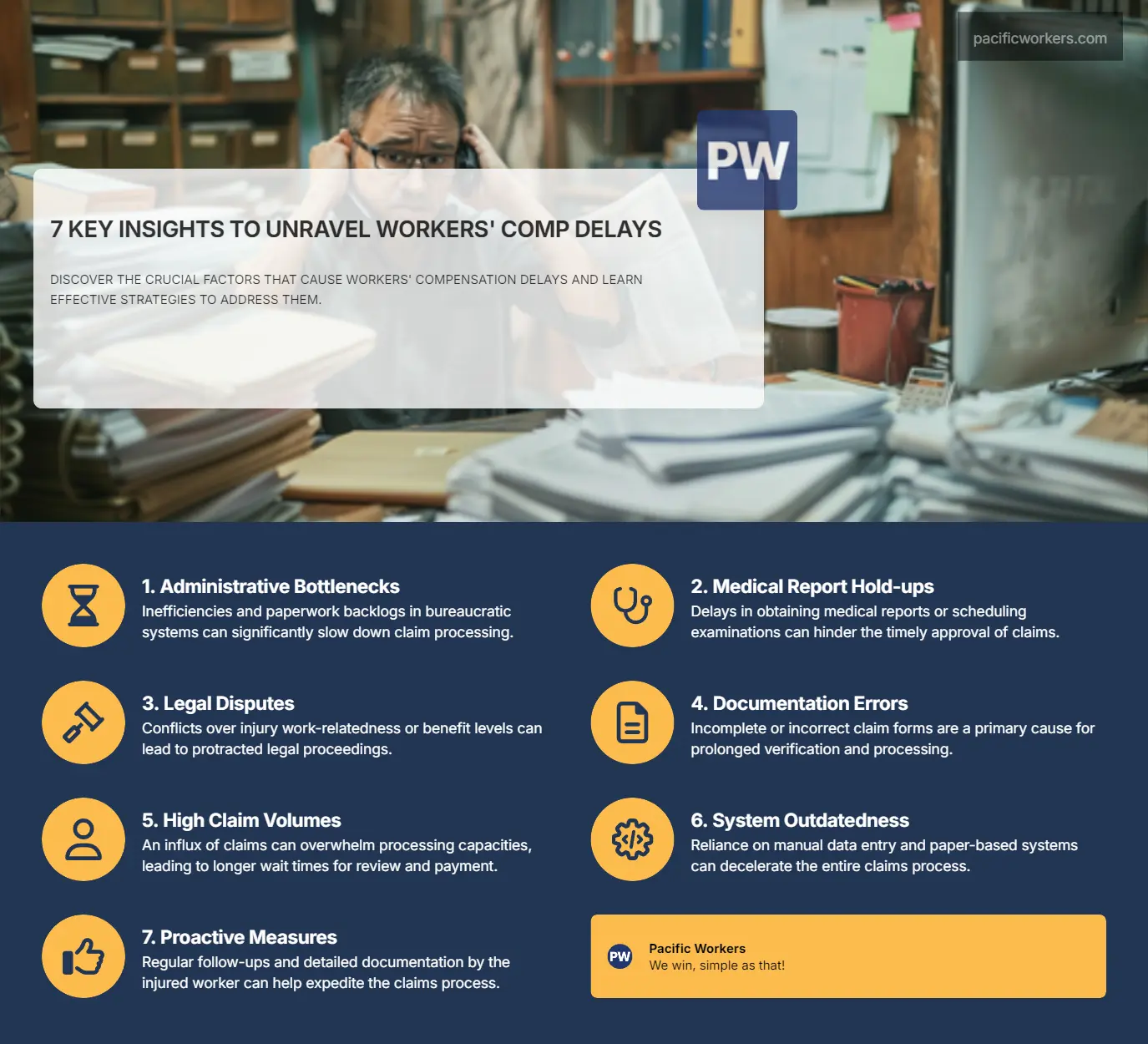
Administrative, medical and legal tardiness have an impact on workers' compensation claims. Take note of how these instances influence those postponements in your employees' payouts.
Administrative Delays
These issues often stem from bureaucratic processes and inefficiencies. Besides, these lapses can show up through slow claim handling. Moreover, the paperwork and the need for meticulous verification of Workers' Comp Checks Delayed can slow down the process.
For instance, paperwork backlogs are another common issue, especially in organizations with outdated systems or insufficient staffing. Miscommunication between the insurance company, employer, and employee can further worsen these stumbles, as a result leading to a frustrating cycle of back-and-forth that stalls the approval and payment of benefits.
Medical Delays
Occur when there are hold-ups in obtaining necessary medical reports or scheduling examinations. These breaks are particularly harmful. For example, when they impact the injured worker's ability to receive timely treatment.
The process of coordinating between various medical providers could be overwhelming. First, ensuring all necessary documentation is complete. And second, waiting for specialist appointments slow down the claims process. Additionally, any discrepancies over medical evaluations can postpone in receiving some benefits.
Legal Delays
They often arise from disputes over the injury's work-relatedness, even for the extent of the injury, or the level of disability benefits. These disputes lead to lengthy legal proceedings, for instance, appeals and hearings, which can postpone the resolution of a claim.
There are postponements such as legal representatives, extra evidence, and complex legal arguments. They're crucial for injured staff members to seek competent legal advice. As a result, employees can't navigate the challenges about Workers' Comp Checks Delayed.
Common Causes of Delays
Incomplete or Incorrect Documentation
Inaccurate information in the claim forms prolongs verification and correction processes. This slows down the initial processing of the complaint but also results in repeated requests for extra information. This way they affect the approval and payment of benefits.
Example: The Missing Doctor's Note
Consider a warehouse worker recovering from a knee injury. His checks arrive on time for two months, then suddenly stop. After days of unanswered calls, he learns why: his doctor's latest work status report, the note saying he still can't return to his job, never reached the claims adjuster. Without it, the insurance company paused his TD payments. Once his attorney's office tracks down the report and sends it over, his payments restart, along with the amount he was owed. One missing piece of paper cost him weeks of stress.
The lesson: after every doctor's visit, make sure your work status report is sent to the adjuster, and keep a copy for yourself.
Disputes and Appeals
Disputes between the employee and employer or insurer are relevant causes of postponements. These conflicts can arise over various aspects of the report:
- The nature of the injury
- The extent of the disability
- The appropriate level of benefits.
The disputes can escalate to formal appeals and legal proceedings, so the resolution process becomes drawn out, besides taking months or even years to conclude.
High Volume of Claims
In periods of major workplace incidents, workers' compensation claims can impact processing capacities. This causes employers to take more time to struggle to manage the influx of reports. Also, the increased workload results in longer wait times for complaint reviews. As a result, approvals and payments could complicate the situation for injured laborers.
System Inefficiencies
Let's talk about outdated administrative systems and a lack of coordination. It happens between involved parties and contributes to delays in settling demands. Manual data entry and paper-based documentation could slow down the entire reports process.
Poor communication between the employee, employer, insurer, and medical providers lead to misunderstandings. So, it causes postponements in the approval and payment of benefits.
Impact on Injured Workers
Financial Hardship
Deferments in receiving workers' compensation benefits lead to financial hardship. Without timely payment, laborers may struggle to cover medical expenses. Because of that, leading them to long-term financial strain.
The inability to pay for necessary treatments creates a cycle of debt, not to mention financial instability, exacerbating the stress associated with their injury.
Physical and Mental Health
Prolonged wait times for medical treatments and benefits have consequences such as:
- Physical injuries
- Contribute to mental stress and anxiety.
- The uncertainty and frustration of dealing with postponed compensations.
Take a toll on an injured worker's mental health.
Moments of depression and anxiety.
Additionally, delays in receiving necessary medical treatments could result in worsening physical conditions. That's to say, prolonging recovery times and leading to permanent disabilities.
Workplace Morale
Perceived inefficiencies in the workers' compensation system affect employee morale. Personnel see their colleagues struggling to receive timely benefits, it's a red flag. It produces distrust within the workplace.
This decreases productivity, increased absenteeism, and a higher turnover rate, thus impacting the organization's performance.
Mitigation Strategies for Workers' Comp Checks Delayed

Streamlined Processes
It's mandatory in implementing an accurate claim proces system and reducing bureaucratic red tape. In that way, minimizes administrative postponements.
Streamlined processes, such as automated verification systems, speed up the approval of complaints. By reducing the reliance on paper-based documentation, organizations improve their reports processing.
Clear Communication
It's crucial to ensure communication between all parties involved in the workers' compensation process. First, for reducing misunderstandings and expediting allegations. Second, regular updates could help keep informed about the status of the claim.
Clear communication resolves disputes faster, reducing the likelihood of lengthy legal proceedings.
Technology Integration
Automated tracking systems improve the efficiency of the repayment process. These technologies offer real-time updates on the status of a demand, besides allowing injured employees to track their progress.
Plus, receiving timely notifications about any required actions. Additionally, technology can help streamline communication, reducing delays and improving coordination.
Training and Support
Training for staff involved in claims processing enhances the workers' comp system. Support programs guarantee that allegations processing staff are the right one. First, are knowledgeable about the latest procedures and best practices.
Further, reducing the likelihood of errors and delays. Likewise, resources, such as counseling services, help to navigate the demands process. And address any challenges they may encounter.
Practical Advices
Consulting with a Compensation Attorney
An attorney drives you to understand the complexities of Workers' Comp Checks Delayed. He/she gathers necessary evidence and represents your interests in disputes and appeals. Even in the event that you need a second opinion for your workers' compensation case. This is an accurate way to get timely and fair remuneration.
Documenting Everything
Please, keep detailed communications and documents related to your workers' compensation claim. This is essential for avoiding tardiness. Also, be sure of the following:
- All paperwork is complete and accurate.
- Maintain copies of all correspondence with your employer, insurer, and medical providers.
- Detailed documentation to track the progress of your report.
- Identify any issues or discrepancies.
- Provide evidence in case of disputes or appeals.
Following Up
Staying proactive in checking the status of your workers' compensation claim. Thus, you help to prevent unnecessary impasses. Every so often, contact the insurance company or your employer for updates on your demand. Then, respond to any requests for more information or documentation.
By staying engaged, you make the processing of your report of Workers' Comp Checks Delayed in the better way possible.
Understanding State-Specific Waiting Periods
The most important thing in Workers' Comp Checks Delayed is knowing the legal waiting periods for settlement benefits. It will help you to prepare for potential delays. Also, check if your state has rules about a holding period before benefits begin, sometimes ranging from three to seven days.
Understanding these anticipation periods helps you manage your expectations. All this, planning according to waiting for your benefits to start.
What to Do If Your Workers' Comp Check Is Late
If a check doesn't arrive when it should, take these steps:
Check the timeline. Is it more than 14 days since your last payment, or since your employer learned about your injury? If so, the payment may be late.
Call your claims adjuster, then follow up in writing. Ask why the payment is late and when it will be sent. An email creates a record.
Make sure your doctor's reports were sent. A missing work status report is one of the most common reasons TD payments stop.
Keep a payment log. Write down the date each check arrives and the amount. This makes late payments and possible penalties easy to prove.
Get help. You can contact the DWC Information & Assistance Unit at 1-800-736-7401, or talk to a workers' comp attorney about whether you're owed a penalty.
Example: When Late Checks Became a Pattern
Now picture a home health aide whose TD checks keep arriving a week or more late, month after month, with no explanation. She's falling behind on rent and doesn't know if she's allowed to complain. She starts writing down every date a check arrives, then brings her log to an attorney. Her attorney uses the record to show a pattern of late payments, and asks for the 10% late payment increases she was owed, plus a penalty for unreasonable delay. Her payments start arriving on schedule, and she's paid the money that was owed to her.
"Keep a simple log: the date each check arrives and the amount. It sounds small, but that one piece of paper is often what turns 'my checks are always late' into penalties the insurance company has to pay."
— Bilal Kassem, Co-Founder of Pacific Workers
Are your workers' comp checks late or missing? Call Pacific Workers at 800-606-6999 for a free case evaluation. We'll find out what's holding up your payments and whether you're owed more.
Frequently Asked Questions
How long does it take to get my first workers' comp check in California?
Your first temporary disability payment is due within 14 days after your employer learns about your injury or illness.
How often are workers' comp checks paid?
Temporary disability checks must be paid every two weeks for as long as you're eligible.
Why did my workers' comp checks suddenly stop?
Common reasons include a missing or expired work status report from your doctor, a doctor's note releasing you back to work, reaching the limit on TD benefits, or a dispute about your claim. The claims administrator must explain in writing why benefits are changing or ending.
Is there a penalty if my workers' comp check is late?
Yes. A late TD payment generally comes with an automatic 10% increase. If there was no reasonable excuse for the delay, you could be awarded up to 25% of the late payment, up to $10,000.
Why wasn't I paid for my first few days off work?
California has a 3-day waiting period for temporary disability. You're paid for those days only if your disability lasts more than 14 days or you were hospitalized overnight.
Conclusions: Navigating Workers' Comp Checks Delayed

- Understanding the legal reasons is crucial for mitigating their impact.
- Administrative inefficiencies, medical hold-ups, and legal disputes are common culprits.
- These postponements affect financial hardship, deteriorating health, and diminished workplace morale.
- By documenting everything, injured laborers better navigate the complexities of the comp system.
- The goal is to ensure timely and fair compensation, so don't let bureaucratic red tape stand in your way.
- Take control of your claim and push for the efficiency and support you deserve.
About the author


Bilal Kassem President and Co-founder
Introducing Bilal Kassem, the visionary leader of Pacific Workers. His unwavering commitment to excellence, empowering others at the core of our organization. With a flair for creativity, Bilal infuses fresh ideas into every initiative we take.
Drawing inspiration from captivating stories like “Goosebumps”, he guides our team with determination. Beyond his professional endeavors, Bilal embraces the great outdoors. As a result, relishing adventures such as backpacking and exploring uncharted territories. Sushi is his preferred treat, nourishing both his body and spirit.
In his free time, he enjoys hitting the gym and indulging in blockbuster films. Also, he finds motivation in the legacies of historical figures like George Patton. By leading with empathy, Bilal fosters a supportive atmosphere. This is why every team member feels empowered to excel.