


When most people hear "workers' comp fraud," they picture one thing: a worker faking an injury to get a check. That does happen. But it's only one piece of the story.
In 2026 alone, California investigators went after an employer accused of hiding nearly $6 million in payroll, a mechanic who pleaded guilty after surveillance contradicted his injury, and a vocational school CEO accused of taking education benefits meant for injured workers. Three cases, three very different people behind the fraud. And in two of them, the people hurt the most were injured workers.
If you've been hurt on the job, you might be asking yourself: Could something like this affect my case? Could I get accused of fraud just for filing a claim? This guide explains what workers' comp fraud in California really is, what the penalties look like, and how to protect yourself, whether you're worried about being accused or you think someone is cheating you.
Key takeaways
- Workers' comp fraud can be committed by employees, employers, medical providers, insurers and even the companies that are supposed to help you.
- Knowingly lying to get benefits, or to deny them, is a crime in California.
- An honest mistake, a good day, or an injury with no witnesses is not fraud.
- If your employer has no workers' comp insurance, you still have a path to benefits.
What Is Workers' Comp Fraud in California?
Workers' comp fraud in California means knowingly making a false or misleading statement, or hiding important information, to get workers' compensation benefits or to deny them. It's covered mainly by California Insurance Code Section 1871.4.
That second part matters. The law doesn't only apply to workers. An employer or insurer who lies to deny a valid claim can be committing fraud too.
The key word is knowingly. Fraud is a deliberate lie. It's not an honest mistake on a form, a date you remembered wrong, or a symptom that changes from one week to the next.
What constitutes workers' comp fraud
Common examples include:
- Reporting a work injury that happened somewhere else, or never happened at all
- Exaggerating pain or physical limitations to get more benefits
- Working another job while collecting temporary disability and hiding it
- Lying under oath during a deposition
- An employer underreporting payroll or hiding employees to pay lower insurance premiums
- An employer or insurer making false statements to deny a real claim
- A provider billing for services that were never given, or paying kickbacks for referrals
And here's what is not fraud:
- Filing a claim for a real work injury. That's your legal right.
- Getting hurt when nobody was around to see it
- Having good days and bad days
- Having your claim denied. A denial is a dispute, not an accusation of a crime.
Is workers' compensation fraud a crime?
Yes. In California, workers' comp fraud can be charged as a felony. A conviction can mean jail or prison time, large fines, restitution and a criminal record. We cover the penalties in detail below.
The Most Common Types of Workers' Comp Fraud

Employee fraud
This is the type that makes the news most often: fake injuries, staged accidents and exaggerated limitations. It's also the type that hurts honest injured workers the most. Every fake claim makes adjusters more suspicious of the next real one.
Employer fraud
Employer fraud is less visible, but it can cost far more. It's also the type most likely to leave you without benefits. Common forms include:
- Premium fraud: Underreporting payroll, paying workers in cash, or hiding employees so the business pays less for insurance
- Misclassification: Calling employees "independent contractors" to avoid coverage
- Going uninsured: Not carrying workers' comp at all, which is illegal for almost every California employer with employees
- Discouraging claims: Pressuring an injured worker to say they got hurt at home
Red flags of workers' compensation premium fraud: You're paid in cash, you never get pay stubs, you're told you're a contractor even though the company controls your hours and work, or your employer tells you not to report an injury.
Medical provider and system fraud
This includes billing for treatment that never happened, unnecessary procedures, and illegal kickbacks for patient referrals. One of the largest cases in California history, the Pacific Hospital of Long Beach scheme, involved kickbacks tied to spinal surgeries on injured workers. As you'll see in Case 3, system fraud can also come from the people who are supposed to help you get back to work.
3 Real Workers' Comp Fraud Cases From 2026
These cases were reported publicly in 2026. Some involve charges that haven't been proven in court. Everyone accused of a crime is presumed innocent until proven guilty.
Case 1: The employer accused of hiding nearly $6 million in payroll
What happened: In March 2026, investigators in Southern California accused the owners of a business of underreporting payroll and employee wages. According to investigators, they paid workers in cash to lower their workers' comp premiums. One owner allegedly used a shell company to hide payroll. The investigation also included fraudulent injury claims involving an employee.
Why it matters to you: When an employer hides workers from its insurance company, the injured worker is the one left without coverage. The employer may even claim you never worked there.
Pacific Workers co-founder Bilal Kassem says this is common, especially in construction and with subcontracted delivery companies. Some workers are dropped off at the hospital and told to say they got hurt at home. Now there are two problems: no insurance, and a medical record that says the injury didn't happen at work.
How to prove you worked there without pay stubs:
- Job site addresses and how long you worked at each one
- Names of coworkers, your supervisor and the foreman
- Text messages, call logs and photos from the job
- Company T-shirts, hats or gear with the business logo
- Records of cash payments, even your own notes
If your employer has no workers' comp insurance, California has a backstop: the Uninsured Employers Benefits Trust Fund (UEBTF). It pays benefits to employees of illegally uninsured employers. The process is slower and more complicated, which is why these cases usually need an attorney.
"The law doesn't care about your immigration status. The law doesn't care about what your past is. You choose to employ people here, you have to play by the rules, and there's no exceptions to that." — Bilal Kassem
In California, workers' comp protects injured employees regardless of immigration status. If you're also being denied overtime, meal breaks or proper pay, you may have a separate wage claim in civil court.
Case 2: The mechanic whose injury was contradicted by surveillance
What happened: A UPS mechanic in Sacramento claimed a large piece of ice fell from the roof of a UPS facility and injured him. Investigators later reviewed surveillance footage that, according to prosecutors, showed nothing fell and he wasn't hurt. He pleaded guilty and, according to a June 2026 announcement, was sentenced to 90 days in jail, two years of formal probation and $50,000 in restitution.
Why it matters to you: Fake claims make the system harder for everyone. Bilal puts it simply:
"If you get hurt at work, you get hurt at work. Don't say you got hurt at work when you did not. There's a thousand ways to prove that you're lying."
But there's a big difference between lying and living with an injury. Maybe you feel better one day and lift a little more than you should. Maybe your child asks you to pick them up, and you do it even though your back hurts. That's not fraud. The problem is when what you do doesn't match what you said you can't do, especially under oath.
Case 3: The vocational school accused of taking injured workers' education benefits
What happened: In February 2026, the CEO of a California vocational return-to-work counseling center and two alleged co-conspirators were charged with 31 felony counts. Investigators say they forged injured workers' signatures, submitted fake enrollment documents and diverted thousands of dollars in education benefits to their own bank accounts.
Why it matters to you: If a permanent disability keeps you from going back to your old job, and your employer doesn't offer you regular, modified or alternative work, you may qualify for the Supplemental Job Displacement Benefit (SJDB). It's a voucher of up to $6,000 for retraining or education. You may also qualify for the Return-to-Work Supplement, a $5,000 payment from the state.
Vocational counselors can help you use these benefits, and many do honest work. But this case shows why you should stay involved:
- Never sign blank or incomplete forms.
- Keep copies of everything you sign.
- Confirm your school is on the state's list of eligible training providers.
- Ask where your voucher money is going, and ask your attorney if something doesn't add up.
"It's fraud, but it's screwing the injured worker even more. You're a provider that's there for the injured worker, supposed to be there for someone in their most vulnerable time." — Bilal Kassem
Watch the full episode of our Podcast
Carmen and Bilal break down all three cases on Work Comp Talk Ep. 164, 3 Real Workers' Comp Fraud Cases. [Insert YouTube link]
Not sure if something in your case is right? Call Pacific Workers at 800-606-6999 for a free consultation.
Workers' Comp Fraud Punishment in California
California treats workers' comp fraud seriously, whether it's committed by a worker, an employer or a provider.
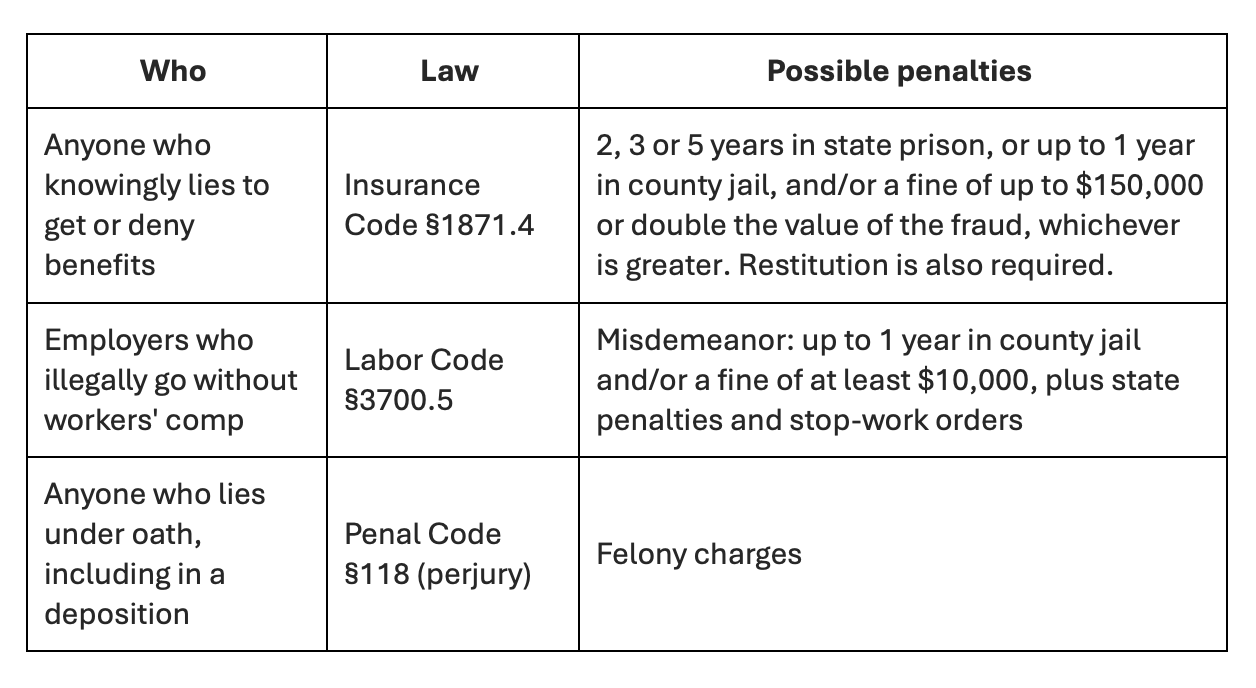
A conviction can also mean losing your workers' comp benefits, probation, and a criminal record that follows you into future jobs.
Red Flags: Signs Your Claim Is Being Investigated
Most adjusters give injured workers the benefit of the doubt, especially early on. Questions usually come later, when a case goes on for a long time or the injury seems inconsistent with the time off work.
Does workers' comp spy on employees?
It can. Insurance companies can legally hire investigators to film you in public places. That can mean your front yard, the grocery store, the gym or your kid's soccer game. This is called sub rosa surveillance. Investigators can't trespass or come into your home, but anything you do in public is fair game.
They also check social media, and not just your own. A video on your spouse's page of you lifting something heavy can end up in your file.
Surveillance often follows a deposition. The defense attorney asks what you can and can't do, and then an investigator checks whether your daily life matches your answers.
Who investigates workers' comp fraud
- The insurance company's Special Investigations Unit (SIU). Insurers are required to report suspected fraud.
- The California Department of Insurance Fraud Division
- County district attorneys, who prosecute the cases
- State agencies like the Labor Commissioner and the Contractors State License Board, for employer violations
How to Protect Your Workers' Comp Claim
If you're honest, you don't need to be afraid. You do need to be careful. These steps protect a real claim:
- Report your injury right away. You have 30 days to tell your employer, but sooner is better. Your employer must give you a claim form (DWC-1) within one working day of learning about your injury.
- Tell every doctor exactly how and where you got hurt, even if your boss asks you to say something else.
- Describe your symptoms accurately. Don't minimize them, and don't exaggerate them.
- Avoid absolutes. Words like "always," "never" and "can't ever" mean exactly that under oath.
- Follow your work restrictions, even on good days.
- Be careful on social media, and ask your family to be careful too.
- Report any other work or income while you're receiving benefits.
- Keep copies of everything, and never sign a form you don't understand.
"It's not that I can't ever walk up those stairs. It'd really hurt, I'd have to take breaks. But when you say 'I can't ever,' 'I never,' or 'I always,' that means never, ever, always." — Bilal Kassem
What If Your Employer Is Committing Workers' Comp Fraud in California?

You don't have to wait until someone gets hurt to act. If your employer is paying people in cash, calling employees "contractors," or telling injured workers to lie, those are warning signs.
Know your rights:
- Retaliation is illegal. Your employer can't fire, demote or punish you for filing a workers' comp claim.
- Immigration status doesn't take away your right to workers' comp benefits in California.
- No insurance doesn't mean no benefits. The UEBTF exists for exactly this situation.
- Don't take your boss's word as final. "There's nothing you can do" is often what an employer says when they're the one breaking the rules.
How to report workers' comp fraud in California
- California Department of Insurance Fraud Division: For suspected workers' comp and premium fraud
- Contractors State License Board (CSLB): For contractors breaking licensing rules
- Labor Commissioner's Office: For unpaid wages, missing overtime, denied breaks or retaliation
- A workers' comp attorney: Especially if you or a coworker got hurt. Wage violations affecting several workers may also support a class action.
When to Talk to a Workers' Comp Attorney
It's time to get legal help if:
- Your claim was denied, or the insurer questions whether you're really hurt
- Your employer says you never worked there, or has no insurance
- You've been scheduled for a deposition
- You think you're being watched or investigated
- Something seems wrong with your SJDB voucher or vocational services
- Your employer pressured you to say the injury happened somewhere else
Workers' comp attorneys in California work on contingency. You pay nothing upfront, and the fee is a percentage of your final award (often around 15%) that a workers' comp judge must approve. If you don't get benefits, you don't pay a fee.
"Ask a lot of questions, be curious, be informed, be an advocate for yourself. Hire a good lawyer, too." — Bilal Kassem
FAQ
What is workers' comp fraud in California?
It's knowingly making a false statement, or hiding important facts, to get or deny workers' compensation benefits. Employees, employers, medical providers and insurers can all commit it. An honest mistake or a denied claim is not fraud.
What is the punishment for workers' comp fraud in California?
It can be charged as a felony. Penalties can include up to 5 years in state prison, fines of up to $150,000 or double the value of the fraud, restitution, probation and the loss of your benefits.
Does workers' comp spy on employees?
Insurance companies can legally hire investigators to record you in public places and review social media, including your family's posts. They can't trespass or enter your home. Surveillance is more common in long claims and after a deposition.
Can I be accused of fraud if no one saw my injury?
An unwitnessed injury is not fraud. Many workers, like delivery drivers, work alone. Report the injury right away, get medical care and describe what happened the same way every time. Consistency is what protects your claim.
How do I report workers' comp fraud in California?
You can report suspected workers' comp or premium fraud to the California Department of Insurance Fraud Division. Report contractor violations to the Contractors State License Board, and wage issues to the Labor Commissioner. If you were injured, talk to a workers' comp attorney first.
Talk to a California Workers' Comp Attorney Today
Fraud cases make headlines, but most injured workers are simply trying to heal, pay their bills and get back on their feet. If your employer is hiding something, your claim is being questioned, or you don't know where your case stands, you don't have to figure it out alone.
Call Pacific Workers at 800-606-6999 for a free consultation. We'll review your situation, explain your options and help you protect the benefits you deserve. There's no upfront cost, and no obligation.
Disclaimer: This article provides general information and is not legal advice. Every workers' compensation case is different.
About the Author
 Bilal Kassem President and Co-founder
Bilal Kassem is the co-founder of Pacific Workers and a nominee for Applicant Attorney of the Year. With a deep-rooted passion for helping injured workers, Bilal leads with empathy and empowers his team to deliver world-class service from the very first interaction.
With nearly 16 years in California workers' compensation, Bilal serves as Pacific Workers' Managing Director of Litigation and was named to The National Trial Lawyers' Top 40 Under 40. He has represented injured workers against uninsured employers through the UEBTF, prepared clients for high-stakes depositions, and pursued employers who exploit their workers in civil court.