


Getting hurt at work turns your life upside down. Between doctor visits, pain, and worrying about your paycheck, paperwork is the last thing on your mind. But in California's workers' comp system, timing matters. Missing a deadline can put your benefits at risk, even when your injury is real and clearly work-related. Here's what you need to know about the time limits, and what to do if you think you've already missed one.
Key Takeaways
- Report your injury to your employer as soon as possible, and no later than 30 days after it happens. Waiting longer can put your benefits at risk.
- If your injury developed over time (like repetitive stress or cumulative trauma), report it as soon as you realize it's connected to your job.
- Your employer must give you a claim form (DWC-1) within one working day of learning about your injury, and forward your completed form to the insurance company within one working day.
- You generally have one year from the date of injury to file your claim. Don't wait. Filing early protects your rights and gets treatment started sooner.
- If your claim isn't denied within 90 days of filing the claim form, it's presumed to be covered.
- Missed a deadline? You may still have options, especially if your employer already knew about your injury. Talk to an attorney before assuming it's too late.
How Long Do You Have to Inform Your Employer?
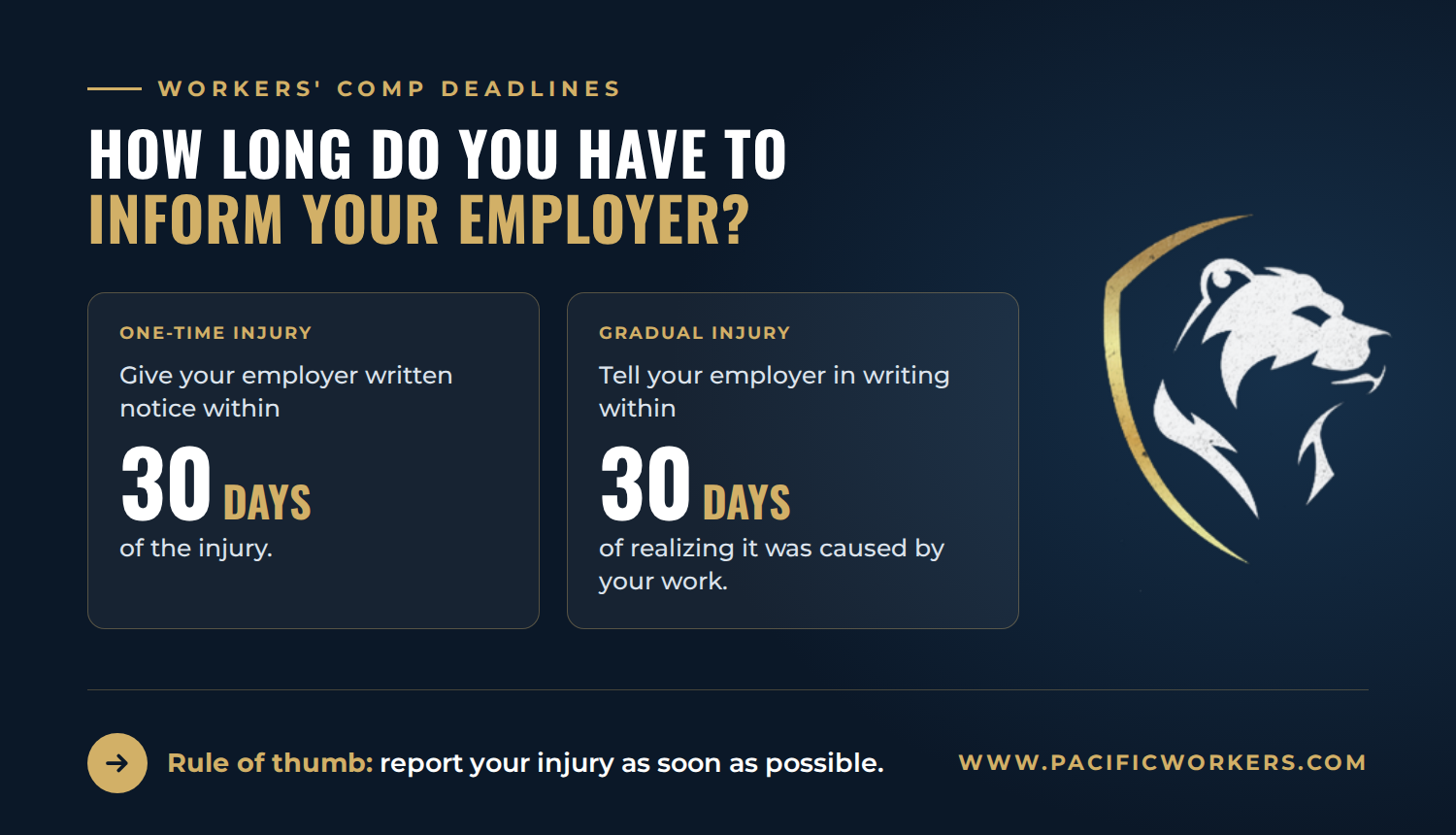
It is important that you provide your employer with written notice of your injury within 30 days. This timeframe can become less clear when the injury has developed gradually and occurred overtime. If this is the case, then you need to report your injury within 30 days of realizing that your injury was due to work. As a rule of thumb, report your injury as soon as possible.
— Yuvanna M. Díaz, Attorney, Pacific Workers
How Long Do You Have to File Your Workers’ Comp Claim?
You generally have 1 year from the date of the injury to file your DWC-1 Claim form. You simply need to hand a completed form to your employer, and they will submit it to the insurance company within one working day.
Although you have an entire year to submit your claim, it is in your best interest to file sooner rather than later. The most time-efficient way of filling for workers' comp claim it to use your completed DWC-1 form as your written notice in the initial 30-day timeframe. Once filed, the case will remain open until it is either settled or denied.
Key Deadlines at a Glance
- Report your injury to your employer: As soon as possible, and within 30 days.
- Employer gives you a claim form (DWC-1): Within one working day of learning about your injury.
- Employer forwards your claim form to the insurer: Within one working day of receiving it.
- Employer authorizes medical treatment: Within one working day of your filing the claim form, up to $10,000 while the claim is being reviewed.
- Insurance company sends a status letter: Generally within 14 days.
- Insurance company accepts or denies your claim: Within 90 days, or the injury is presumed covered.
- File your claim: Generally within one year of the date of injury.
What Happens After You File
Once your employer has your completed DWC-1, the clock starts running for them, too. The employer must authorize appropriate medical treatment within one working day, and you can receive up to $10,000 in treatment while the insurance company investigates. If the insurance company doesn't deny your claim within 90 days, your injury is presumed to be covered. That's one more reason to file early: the sooner you file, the sooner these protections kick in.
What Will Happen If I Report the Claim Late?

If you fail to report the injury to your employer within 30 days, then you do risk not being eligible for compensation. Regardless, according to California Labor Code Section 5402, if you can prove that your employer should have known about the injury, you remain eligible.
For example:
- You are still eligible for compensation if you have complained to your employer about physical pain from a work activity/duty.
- You are still eligible if another employee has informed your employer that you had a work related accident.
Example: When a Supervisor's Knowledge Saved the Claim
Consider a grocery stocker who strains his back lifting cases of water. He mentions it to his shift supervisor that night, but he doesn't fill out any paperwork, thinking it will heal on its own. Two months later, the pain is worse and he can't lift at all. When he finally files a claim, the insurance company argues the report was too late. But his supervisor remembers the conversation, and a coworker saw him grab his back that day. Because his employer already knew about the injury, he still has a path forward. The claim becomes much harder than it needed to be, but it isn't lost.
Example: An Injury That Built Up Over Time
Now picture a medical assistant who has typed and handled charts for years. Her wrists have ached for months, but she assumes it's just part of getting older. When her doctor finally tells her it's carpal tunnel syndrome related to her work, that's the moment her reporting clock starts. She tells her manager in writing that same week and files a DWC-1. Because she acted as soon as she learned the connection, her cumulative trauma claim moves forward without a timing dispute.
"With injuries that build up over time, the question isn't 'When did it start hurting?' It's 'When did you know it was caused by your job?' Once you know, act fast. And if you're not sure whether you're still within the deadline, call us before you assume the answer is no."
— Bilal Kassem, Attorney, Pacific Workers
What to Do If You Think You Missed a Deadline
Don't give up on your claim just because time has passed. Instead:
- Report the injury now, in writing. A late report is better than no report.
- Write down who knew and when. Note any supervisor you told, coworkers who saw the injury, texts, emails, or first-aid visits.
- Gather your medical records. Records that connect your injury to your job help prove your case.
- Talk to a workers' comp attorney. Deadlines have exceptions, and an attorney can tell you whether one applies to you.
Worried you waited too long? Call Pacific Workers at 800-606-6999 for a free case evaluation. It may not be too late.
Frequently Asked Questions
How long do I have to report a work injury in California?
You should report your injury to your employer as soon as possible, and within 30 days. Waiting longer can put your right to benefits at risk.
What if my injury happened gradually over time?
For cumulative trauma, like repetitive stress injuries, report it as soon as you learn or believe it was caused by your job.
Does telling my supervisor count as reporting?
Telling your supervisor is an important first step, and it can help prove your employer knew about the injury. But you should also put it in writing and complete a DWC-1 claim form to fully protect your rights.
What if my employer refuses to give me a claim form?
Your employer is required to give or mail you a claim form within one working day of learning about your injury. If they don't, you can get the DWC-1 form from the Division of Workers' Compensation website, and you should contact an attorney.
Can I still file a claim after one year?
In some situations, yes. Exceptions can apply, for example if you were receiving benefits or your employer failed to give you proper notice of your rights. An attorney can review the facts of your case.
Contact Pacific Workers’ The Lawyers for Injured Workers
If you failed to report your workers' comp claim in the appropriated timeframe, then contact an Oakland workers' compensation lawyer. We may still be able to help and will work hard to develop your claim, argue its merits, and fight to get you the compensation that you deserve.
Pacific Workers', The Lawyers for Injured Workers, is Northern California's Premier Workers' Compensation Applicant firm. We represent First Responders, Health Care Workers, Construction Workers, Retail Workers, Warehouse Workers, Delivery Drivers, and the other hard-working people that keep our community moving in their Fight for Justice against the Insurance Companies.
With over 250+ Five-Star Reviews, an incredible staff of caring, well-trained caring, advanced technology for superior client communication, a track record of an over 96% win rate, and giving back to our community through the Pacific Workers' Foundation. It is easy to see why Pacific Workers' is the go-to law firm for all injured workers in Northern California.
If you or a loved one needs our help or just has a question, give us a call at 800-606-6999. We are here to serve.
Disclaimer: This article is for general informational purposes only and is not legal advice. Every case is different. For advice about your situation, speak with a licensed California workers' compensation attorney.
About the author
 Bilal Kassem President and Co-founder
Introducing Bilal Kassem, the visionary leader of Pacific Workers. His unwavering commitment to excellence, empowering others at the core of our organization. With a flair for creativity, Bilal infuses fresh ideas into every initiative we take.
Drawing inspiration from captivating stories like “Goosebumps”, he guides our team with determination. Beyond his professional endeavors, Bilal embraces the great outdoors. As a result, relishing adventures such as backpacking and exploring uncharted territories. Sushi is his preferred treat, nourishing both his body and spirit.
In his free time, he enjoys hitting the gym and indulging in blockbuster films. Also, he finds motivation in the legacies of historical figures like George Patton. By leading with empathy, Bilal fosters a supportive atmosphere. This is why every team member feels empowered to excel.